
|
|

We will find it profitable to generalize for any number, let’s call it N, that the sum of digits up to N is simply
|

The Sum Of The Periods Digits recapture method adds one more little twist. The portion of the finance charge to be recovered in each payment is weighted by a digit that represents the number of remaining payments. In a 360 payment loan, the first payment is assigned the digit 360; the second payment is assigned the digit 359; the third payment is assigned the digit 358; and so on down the line to the 360th payment, which is assigned the digit 1. The weight of the first payment is divided by the sum-of-the-periods-digits to figure the proportion of the finance charge that is repaid by the first payment received. It is easy to figure:
|
The second payment’s weight, similarly, is
|
And so also similarly, the third:
|
These weight factors are calculated all the way down to the 360th payment, whose weight is a very meager
|
Each payment’s weight factor is multiplied times the contracted total finance charges to arrive at the amount of interest that will be paid off for that payment period.
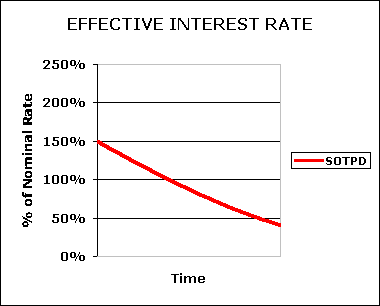
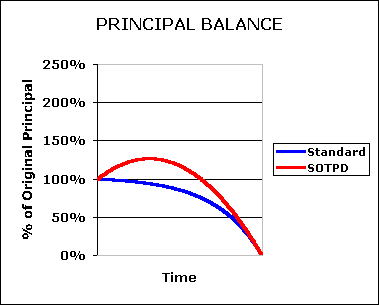
The effects of this mathematical manipulation over the life of the loan can be seen in the charts below:
|
|
ADVANTAGES THE LENDER ENJOYS
In the early part of the loan, the lender enjoys an effective return on investment at least 150% of the contract interest rate. In the event of foreclosure, any difference between the market value of the asset foreclosed and the principal still outstanding must be borne, nonetheless, by the borrower. The lender wins even if foreclosure occurs late in the life of the loan.