|
|
HOW IT WORKS — The payments are numbered from lowest to highest period number (this is the the natural order). Negative exponential function is applied, using as its argument for each period the period number times the result of dividing 5 by the number of payement periods. This weight then is divided by the sum total of period weights. The total finance charge is multiplied times this weight to obtain the interest payment for the period.
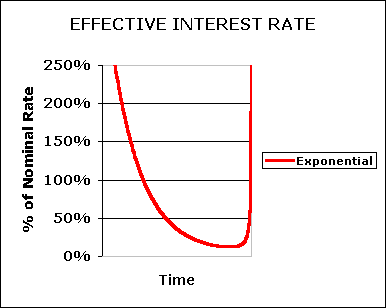
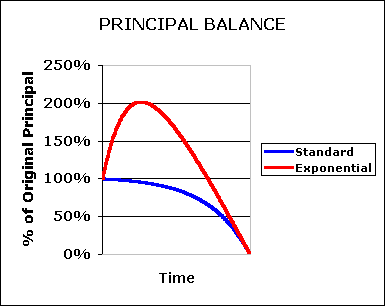
The effects of this mathematical manipulation over the life of the loan can be seen in the charts below:
|
|
|
In the early part of the loan, the lender enjoys a return on investment that exceeds 375% of the contract rate. Late in the loan’s life, the rate of return rises precipitously to 250% of the contract rate. In the event of foreclosure, any difference between the market value of the asset foreclosed and the principal still outstanding must be borne, nonetheless, by the borrower.