|
ANNUAL PERCENTAGE RATE The cost of your credit as a yearly rate
|
FINANCE CHARGE The dollar amount the credit will cost you $ 44,782.14 |
AMOUNT FINANCED The amount of credit provided to you or on your behalf $90,890.00 |
TOTAL OF PAYMENTS The amount you will have paid after making all payments as scheduled $ 135,572.14 |
It bears repeating: all contracts (including credit cards) begin by making a calculation of interest you will pay for one payment period using simple interest. In order to calculate the FINANCE CHARGE block above, the finance company merely adds up all the interest you will be charged over the entire term of the loan.
You, in turn, will sign the bottom of the form promising to pay ALL OF THE MONEY IN ALL THE MONEY BLOCKS ON THE FORM.
Where is the rub? The rub is this: you have no idea yet, from the simple interest calculation in the first two blocks, just how the finance company wants you to pay them the FINANCE CHARGE block on the form. And, the law pretty much lets the finance company decide how this is to be done.
FINANCE CHARGE PAYMENT TERMS ARE ALWAYS IN THE FINE PRINT
This particular contract we are looking at is for the refinancing of a home. Buried on page 6 of the contract (it is printed on legal size paper, dark pink in color, using very small print indeed!) there is a paragraph that begins, “This is a simple interest contract. Payments shall be made in equal periodic installments. Principal shall be credited or debited only after interest has been credited from each such installment. Interest shall be credited using standard recapture of the finance charge amount agreed upon above.” [emphasis added]
This is fairly typical wording for a home loan. But what does it mean to YOU, the borrower?
Parse it carefully, and make note of what you may not understand. What should stand out in your mind concerns two things. What do they mean by debiting the principal? What do they mean by standard recapture of the finance charge?
Debiting the principal means that if a payment they receive from you is too small to cover interest and principal, the interest gets paid first. If you still owe more money, the money gets added to the principal. You say, “Well, that is fair. If I send in a payment for $100 but I was supposed to send $200, I expect to have to pay more the next time, or be charged a late charge this time, or somehow be penalized for it farther down the road.”
The only thing is, that is NOT what the terminology actually says. Of course, it applies in the situation that came to your mind, when you send $100 but the contract clearly says $200. The problem is, it also applies if you send the $200 the contract calls for you to send in, but the following term says something except standard recapture of the finance charge.
STANDARD VS. NON-STANDARD FINANCE CHARGE RECAPTURE
STANDARD RECAPTURE — When most people think of amortization, they are thinking about standard finance charge recapture. Simply put, if you borrow $100,000 and agree to a rate of 1% per month, the interest at the end of the first month is $1,000. Using the simple interest calculation, if you agree to pay the loan off in equal payments of $1,200.17 every month for 15 years, in the first payment you will pay the $1,000 for the interest that is due and the remaining $100.17 will be used to pay a little bit of the principal down. The principal balance will then fall to $100,000 - 100.17 = $99,899.83. The following month, the interest will be $999.00 (1% of $99,899.83), and each succeeding month the interest will continue to fall as the principal is paid off. Conversely, the amount of principal paid off with each payment very gradually increases each month until it is paid off completely 180 months later.
As was mentioned earlier, this is the way (typically) that home loans are set up. This is called SIMPLE INTEREST, STANDARD AMORTIZATION. The thing is, homes are about the only thing in the world of finance that are set up this way. Chances are that you are paying on a NON-STANDARD AMORTIZATION schedule if you borrow for any of the following kinds of items:
 buying a modular house
- buying a “factory-built” home
- buying an RV
- buying a mobile home trailer
- buying a car
- leasing a car
- buying a heavy use, over-the-road tractor-trailer rig
- leasing to buy a heavy use, over-the-road tractor-trailer rig
- furniture
- appliances
- contracts to buy land and houses
- borrowing against a future paycheck at a “money store” or pawn broker
- buying or leasing farm equipment
- “factoring” inventories or supplies required for your business
- buying a bail bond
- don’t forget your credit cards!
to only mention a few (a very few!).
NON-STANDARD RECAPTURE - There are precisely 7 non-standard kinds of amortization permitted by the laws of different states. I have lived recently in 3 states where all 7 are actually legal!
What these non-standard amortization methods have in common is a real contrast of extremes with standard amortization.
In standard amortization,
|
(1) |
the interest for the period is based on the remaining principal at the beginning of the period |
|
(2) |
as installment payments are made, the amount of interest paid in each period gradually falls, |
|
(3) |
while the amount of principal gradually increases, until the loan is fully paid off |
|
(4) |
from one period to the next, the interest rate is the same |
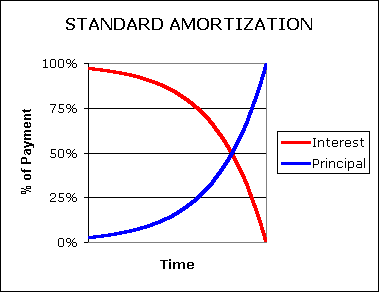
In non-standard amortization,
|
(1) |
the interest for the period is based on mathematical manipulation of the FINANCE CHARGE with a view to |
|
(2) |
greatly accelerating the payment of the entire FINANCE CHARGE as rapidly as possible |
|
(3) |
normally adding a great deal to the principal balance, because installment amounts are (at least initially) unable to pay all of the accelerated interest recapture (remember the clause: “Principal shall be credited or debited only after interest has been credited from each such installment.” |
|
(4) |
from one period to the next, the effective interest rate can be, and frequently is, shockingly gigantic |
SEVEN (7) NON-STANDARD (ACCELERATED FINANCE CHARGE RECAPTURE) AMORTIZATION SCHEMES
In the linked discussions below, the advantages (to the lender) of each accelerated recapture scheme will be discussed, as well as the mathematical formula upon which each depends. Charts will show the effect of each scheme on the principal balance and effective interest rate, too.
|
(Sum Of The Periods Digits) |
|
|
(150% Declining Balance) |
|
|
(200% Declining Balance) |
|
|
|
|
|
|
|
|
|
|
|
|